
Best Pandit In Trimbakeshwar
Introduction
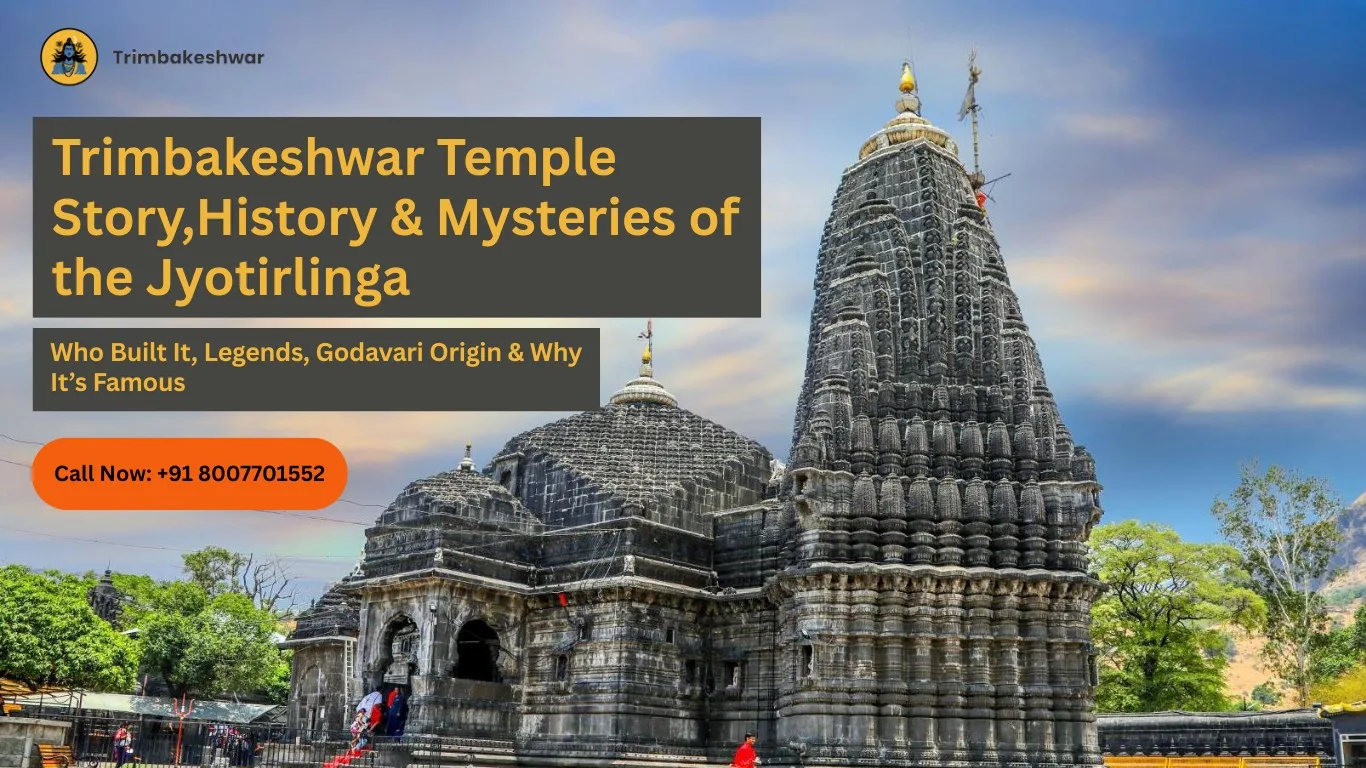
Trimbak located in Nashik, is home to Trimbakeshwar Temple, one of the most holy pilgrimage locations in Maharashtra. It is one of the twelve Jyotirlingas of Lord Shiva. Aside from the spirituality, the temple also has its share of history, myths, and legends which makes it unique. The temple attracts countless visitors each year and is the source of the holy Godavari River.
The temple also encompasses and presents the spirituality and cultural wealth of the nation. In this blog, we will provide more information on the history of this temple, the mysteries, legends, significance, and the person who built it.
Key Highlights:
- Sacred Jyotirlinga – Trimbakeshwar is one of the 12 Jyotirlingas of Lord Shiva.
- Rich History – Mentioned in Puranas; current temple built in the 18th century by Peshwa Balaji Baji Rao.
- Unique Shivling – Three faces of Brahma, Vishnu, and Shiva in one lingam.
- Godavari Origin – River Godavari begins at Kushavarta Kund near the temple.
- Spiritual Significance – Famous for Kaal Sarp Dosh, Pitra Dosh, and other Vedic pujas.
The Story of Trimbakeshwar Temple
Trimbakeshwar Temple in the Puranas
The history about Trimbakeshwar is depicted in the Shiva Purana and Skanda Purana. There it is stated that Gautama Rishi, a sage and a devoted worshipper, lived and performed his great penance in this region. Shiva was so moved by the sage’s dedication that he permitted the Ganga to descend to Trimbak, and in the form of the Godavari river.
This means that Trimbakeshwar is not only a Jyotirlinga, but also the source of one of the holy rivers of India. It is said that taking a bath in the Godavari, especially at the temple’s Kushavarta Kund, washes away sins and frees a person from the cycle of re-birth.
The Trimbakeshwar Jyotirlinga
Trimbakeshwar is unique compared to other Jyotirlingas because of the form of its lingam. Instead of a single lingam, the sanctum contains a three-faced Jyotirlinga representing a holy trinity of Brahma, Vishnu, and Shiva. This embodiment greatly enhances the spiritual importance of the temple.
Due to its Jyotirlingas power to grant liberation (moksha), Trimbakeshwar is central to the performance of ancestral rites, dosh nivaran pujas, and moksha-giving rituals.
Historical Timeline of Trimbakeshwar Temple
| Period | Event | Significance |
|---|---|---|
| Ancient Times | Mentioned in the Shiva Purana & Skanda Purana | Established as a sacred Jyotirlinga and revered as the origin of the Godavari River |
| Medieval Period | Saints and sages performed intense rituals at Trimbak | Became a renowned center for penance, meditation, and worship |
| 18th Century | Temple construction by Peshwa Balaji Baji Rao | Showcases the grandeur of Hemadpanthi architecture |
| Modern Times | Ongoing preservation and restoration efforts | Celebrated as a spiritual landmark and an important cultural heritage site |
History of Trimbakeshwar Temple
How Old Is Trimbakeshwar Temple?
With regards to the temple site, Trimbakeshwar has been a place of worship for many years, as the site is found in ancient religious texts, dating to several thousand years. That said, the remaining structure of the temple today is about 300 years old, dating to the 18th century.
Who Built Trimbakeshwar Temple?
The temple which we see today was built during the 18th century by Peshwa Balaji Baji Rao, aka Nana Saheb Peshwa. He also built the temple using the Hemadpanthi architectural style, which is known for its locally available black basalt stone and strong lime-based construction.
Timeline of Trimbakeshwar Temple History
- Ancient Times: Revered in Puranas as a Jyotirlinga and the source of the Godavari River.
- Medieval period: Saints and devotees came to Trimbak to worship and perform rituals.
- 18th Century: Peshwa Balaji Baji Rao built the current grand temple structure.
- Modern Times: Recognized as a site of major spiritual and cultural heritage, with restoration projects for the eroding Shivling.
Unique Features and Mysteries of Trimbakeshwar Jyotirlinga
What Is the Mystery of Trimbakeshwar Temple?
The Trimbakeshwar Jyotirlinga has some of the most interesting eroded features of the Shivling. People spend a lot of time and money to try to preserve and protect it, yet it continues to deteriorate. Devotees consider it a spiritual blessing that they believe is a reminder of the cosmic cycle. This is a reminder that life is impermanent.
Another unique feature is that devotees are not allowed to touch the Shivling. Unlike other Jyotirlingas, only priests can perform abhishekam and rituals, while devotees must witness from a distance. This rule further highlights its sacredness.
The Sacred Pillar and Temple Architecture
The temple is a fine example of Hemadpanthi architecture style. it has carved pillars, stone courtyards and exquisite statues. The sanctum is topped with a beautifully made spire and is surrounded by halls that display Maratha artistry. The stone pillars make the area grand and symbolize strength and stability.
Legends Associated with Trimbakeshwar Temple
The Godavari River Origin
Trimbak, located in Nashik, is home to Trimbakeshwar Temple, one of the most holy pilgrimage locations in Maharashtra. It is one of the twelve Jyotirlingas of Lord Shiva. Aside from the spirituality, the temple also has its share of history, myths, and legends, which make it unique.
The temple attracts countless visitors each year and is the source of the holy Godavari River. The temple also encompasses and presents the spirituality and cultural wealth of the nation. In this blog, we will provide more detailed information on the history of this temple, the mysteries, legends, significance, and the person who built it.
The Story of Trimbakeshwar Temple
Trimbakeshwar Temple in the Puranas:
The history of Trimbakeshwar is depicted in the Shiva Purana and Skanda Purana. It is stated that Gautama Rishi, a sage and a devoted worshipper, lived and performed his great penance in this region. Shiva was so moved by the sage’s dedication that he permitted the Ganga to descend to Trimbak in the form of the Godavari River.
This means that Trimbakeshwar is not only a Jyotirlinga, but also the source of one of the holy rivers of India. It is said that taking a bath in the Godavari, especially at the temple’s Kushavarta Kund, washes away sins and frees a person from the cycle of rebirth.
The Trimbakeshwar Jyotirlinga
Trimbakeshwar is unique compared to other Jyotirlingas because of the form of its lingam. Instead of a single lingam, the sanctum contains a three-faced Jyotirlinga representing a holy trinity of Brahma, Vishnu, and Shiva. This embodiment greatly enhances the spiritual importance of the temple.
Due to its Jyotirlinga’s power to grant liberation (moksha), Trimbakeshwar is central to the performance of ancestral rites, dosh nivaran pujas, and moksha-giving rituals.
History of Trimbakeshwar Temple
How Old Is Trimbakeshwar Temple?
With regards to the temple site, Trimbakeshwar has been a place of worship for many years, as the site is found in ancient religious texts, dating back several thousand years. That said, the remaining structure of the temple today is about 300 years old, dating to the 18th century.
Who Built Trimbakeshwar Temple?
The temple, which we see today, was built during the 18th century by Peshwa Balaji Baji Rao, aka Nana Saheb Peshwa. He also built the temple using the Hemadpanthi architectural style, which is known for its locally available black basalt stone and strong lime-based construction.
Timeline of Trimbakeshwar Temple History
- Ancient Times: Revered in Puranas as a Jyotirlinga and the source of the Godavari River.
- Medieval period: Saints and devotees came to Trimbak to worship and perform rituals.
- 18th Century: Peshwa Balaji Baji Rao built the current grand temple structure.
- Modern Times: Recognized as a site of significant spiritual and cultural heritage, with restoration projects for the eroding Shivling.
Unique Features and Mysteries of Trimbakeshwar Jyotirlinga
The Mystery of the Shivling
The Trimbakeshwar Jyotirlinga has some of the most interesting eroded features of the Shivling. People spend a lot of time and money to try to preserve and protect it, yet it continues to deteriorate. Devotees consider it a spiritual blessing that they believe is a reminder of the cosmic cycle. This is a reminder that life is impermanent.
Another unique feature is that devotees are not allowed to touch the Shivling. Unlike other Jyotirlingas, only priests can perform abhishekam and rituals, while devotees must witness from a distance. This rule further highlights its sacredness.
Architectural Beauty
The temple is a fine example of the Hemadpanthi architectural style. It has carved pillars, stone courtyards, and exquisite statues. The sanctum is topped with a beautifully made spire and is surrounded by halls that display Maratha artistry. The stone pillars make the area grand and symbolize strength and stability.
Legends Associated with Trimbakeshwar Temple
The Godavari River Origin
Folklore tells us Gautama Rishi’s story as one of the temple legends. In the rishi’s ashram, a cow was killed, so he sought atonement. To do this, he performed a penance. For a long time, he wanted the Ganga River to come to Trimbak. After this prayer to Lord Shiva, a river was released, and it became the Godavari River and emerged from the Kushavarta Kund. This is now the main area to bathe before going to the temple.
Importance Among Jyotirlingas
Trimbakeshwar is specifically essential for the moksha. It is believed to be one of the Jyotirlingas. For a piece of the soul and to gain liberation, Hindus can perform the last rites, Pitra Dosh Puja, or Narayan Nagbali here. It is also of great help to the souls for their karmic debts.
Recent Restoration and Preservation Efforts
Shelters have been built to protect the Shivling since, for the last few centuries, devotees have seen the erosion as a sign from God. Divine or not, temple trust and government bodies have taken initiative to protect the sacred site. Some of these protective measures include cultural charter recognition, crowd control, and structural fortification. To this date, the temple traditions and sanctity have not changed in the slightest.
Visiting Trimbakeshwar Temple Today
Location and Access
Beautiful hills and nature surround Trimbakeshwar Temple, which is about 28 km from the city of Nashik and is located in the state of Maharashtra. Travelers from Mumbai, Pune, and Nashik can drive to Trimbakeshwar. If you’re traveling from out of the country or a different state, you can also find a train station and an airport in Nashik.
Rituals and Pujas Performed
For the powerful remedial pujas, Trimbakeshwar is the puja center that attracts devotees from all of India. Some of the well-known include:
- Kaal Sarp Dosh Puja – it is to overcome the hurdles of poor planetary placement.
- Narayan Nagbali Puja – it is for the peace of the family souls and to create peace in the family.
- Pitra Dosh Puja – it is to get the blessings from the ancestors and to remove the negative ancestral impacts.
All of the above are performed by educated and trained pandits according to Vedic standards.
Frequently Asked Questions (FAQ)
How old is Trimbakeshwar Temple?
The site of the temple is a few thousand years old and mentioned in the Puranas. The current structure is about 300 years old, built in the 18th century.
Who constructed the Trimbakeshwar Temple?
The current temple was built in the Hemadpanthi style by Peshwa Balaji Baji Rao.
What is the story behind Trimbakeshwar Jyotirlinga?
It is said that Lord Shiva blessed Gautama Rishi and opened the Godavari River for him, and it flows from Trimbak. The Jyotirlinga holds the powers of Brahma, Vishnu, and Shiva.
What is the mystery of Trimbakeshwar Shivling?
The Shivling is eroding slowly, and the devotees believe it is a divine sign.
Why is Trimbakeshwar Temple famous?
Because it is one of the 12 Jyotirlingas, it is the source of the Godavari River, and is a location for powerful Kaal Sarp Puja and Pitra Dosh Puja rituals.
Which king built Trimbakeshwar Temple?
Peshwa Balaji Baji Rao (Nana Saheb) built the temple in the 18th century.
What makes Trimbakeshwar unique among the 12 Jyotirlingas?
It is the only Jyotirlinga that has a lingam with three faces that symbolize Brahma, Vishnu, and Shiva, all in one.






Comments
One response to “Trimbakeshwar Temple Story & History: Who Built It, Legends, and Mysteries of the Jyotirlinga”
[…] Trimabkeshwar of Nashik is the main kshetra for Narayan Nagbali. Trimbak is mentioned in the Garuda Purana and Dharma Shastra as the most powerful place for all Pitru Karmas. The origin of Godavari and Trimbakeshwar Jyotirlinga makes the holy ritual more effective. Many families choose Narayan Nagbali Puja in Nashik and Trimbakeshwar because of this. […]